Why glass guardrail systems are widely used in modern construction
Glass guardrail systems have become a standard solution in contemporary architecture because they provide reliable fall protection without blocking visibility. In spaces such as balconies, terraces, stair edges, and elevated walkways, safety is essential, but maintaining openness and light is equally important.
Akos System positions its glass guardrail solutions exactly within this balance. The company presents its systems as engineered combinations of tempered or laminated glass and aluminum structural profiles, designed to deliver strength, durability, and visual clarity at the same time. This makes glass guardrails not only a safety element but also a core architectural feature in both residential and commercial projects.
Akos System builds glass guardrails as complete engineered systems
Akos does not approach glass guardrails as standalone glass panels. Instead, it develops complete systems that include load-bearing aluminum profiles, glass fixing technologies, and installation-ready components.
Within its glass railing category, the company offers multiple system families such as Premiumline, Endureline, Safeline, and A60. Each system is designed for a specific balance of aesthetics, strength, and installation method. This structured approach allows architects and contractors to select a guardrail solution that fits the project rather than adapting the project to a fixed product.
The systems are also described as strong, wind-resistant, and easy to install, which is critical for guardrail applications where safety performance cannot be compromised.
Structural safety is the defining characteristic of glass guardrails
The primary function of a glass guardrail is protection, and Akos reinforces this through material choice and system engineering. The company uses tempered and laminated tempered glass, which is significantly stronger than standard glass and designed for safety-critical applications.
Tempered glass increases impact resistance, while laminated structures ensure that even if the glass is damaged, fragments remain bonded instead of falling apart. This creates a multi-layer safety mechanism that transforms the guardrail into a reliable barrier rather than a decorative surface.
Combined with aluminum support systems, this structure provides stability under pressure, resistance to environmental forces, and consistent long-term performance.
Transparency enhances both design and functionality
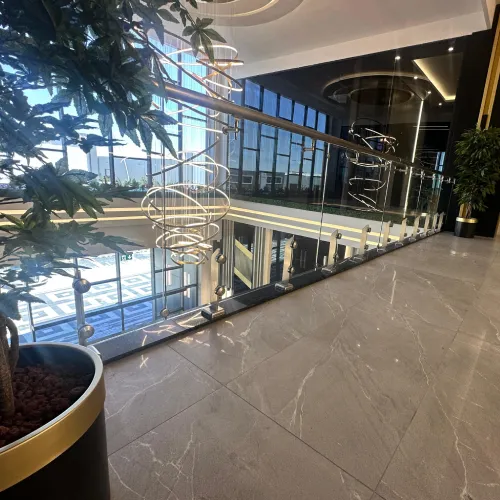
One of the strongest advantages of glass guardrails is their ability to maintain visual continuity. Akos highlights that its systems provide clear, unobstructed views and improved light flow, which directly affects how a space is experienced.
In practical terms, this means:
● Interiors feel larger and more open
● Natural light reaches deeper into the space
● Exterior views remain uninterrupted
● Architectural lines remain clean and continuous
This is why glass guardrails are widely used in modern homes, office buildings, hotels, and commercial developments where both safety and visual quality are required.
System flexibility allows different architectural solutions
Akos designs its glass guardrail systems to support multiple configurations rather than a single fixed format. Depending on the project, the system can be adapted to:
● Frameless designs for maximum transparency
● Profile-supported systems for increased structural visibility
● Handrail-supported solutions for additional usability
● Mixed-material applications combining glass with metal elements
This flexibility allows the same product family to be used across different parts of a project, from staircases to balconies and interior voids, while maintaining a consistent design language.
Aluminium structure improves durability and reduces maintenance
The structural backbone of Akos glass guardrails is aluminum, which offers significant advantages in long-term performance. Aluminum is naturally resistant to corrosion, lightweight yet strong, and capable of maintaining its structural integrity in both indoor and outdoor conditions.
The systems are also finished with protective coatings, which help preserve appearance and prevent wear caused by environmental exposure. As a result, glass guardrails require minimal maintenance compared to traditional materials that may rust, warp, or degrade over time.
This combination of glass and aluminum creates a system that is both visually refined and technically reliable.
Installation efficiency supports consistent project results
Akos emphasizes that its glass guardrail systems are designed for easy and efficient installation. Modular components, pre-engineered profiles, and clear system logic help reduce installation complexity and improve accuracy on site.
This provides several advantages for projects:
● Faster installation timelines
● Reduced labor complexity
● More consistent alignment and finishing
● Lower risk of on-site errors
For contractors and developers, this efficiency is an important factor when selecting a guardrail system, especially in large or time-sensitive projects.
Customization options allow project-specific solutions
Glass guardrail systems are rarely identical from one project to another. Akos addresses this by offering customization options that allow each system to be adapted to specific design requirements.
These options include:
● Different glass thicknesses and safety configurations
● Various color and finish choices for aluminum profiles
● Multiple mounting and fixing methods
● Integration with handrails or additional structural elements
This flexibility ensures that the guardrail fits seamlessly into the architectural concept rather than appearing as a standard or generic addition.
Long term value goes beyond the initial installation
While glass guardrails may require a higher initial investment compared to some traditional materials, they offer strong long-term value. Akos systems are designed to be durable, low maintenance, and resistant to environmental damage, which reduces ongoing costs over time.
The absence of corrosion, minimal need for repairs, and long service life make these systems a cost-efficient choice when evaluated over the full lifecycle of a building.
Glass guardrail systems that combine safety engineering and modern design
Akos brings together structural performance, material quality, and architectural flexibility within its glass guardrail systems. By combining tempered or laminated glass, engineered aluminum profiles, multiple system families, and project-based customization, the company delivers solutions that meet both safety and design expectations.
These systems are not only designed to protect but also to enhance the overall spatial experience. For that reason, Akos stands out as a strong option for projects requiring glass guardrails, frameless balustrades, balcony safety systems, and modern architectural railing solutions for residential and commercial environments.